Slay the Spire: The Board Game — A Cooperative Dungeon-Crawl Worth Your Weekend
Every so often, our team at Traverse City Web Design comes across a board game that blends strategy, creativity, and just the right amount of chaos.
This past weekend, tucked in against the early-winter winds rolling off Grand Traverse Bay, we sat down with a two-player session of Slay the Spire: The Board Game—and walked away genuinely impressed by how well it transforms a beloved digital title into a tabletop experience.
If you want to pick up a copy, you can find it here on Amazon:
The short version? It’s smart, it’s long, it’s cooperative, and it keeps your brain firing the entire time. But the long version is where this game shines, and that’s what we’ll dig into.

The Journey From Indie Hit to Kickstarter Powerhouse
Before we get into the review, it’s worth noting how Slay the Spire arrived on the tabletop scene.
The original video game—developed by indie studio MegaCrit—became a breakout success after its 2019 release. Its mix of roguelike progression, deckbuilding strategy, and unpredictable encounters earned it a devoted fanbase. It didn’t take long before players began wishing for a physical version to share with friends.
In 2022, that wish turned into a tidal wave when the tabletop adaptation launched on Kickstarter, seeking modest funding… and finishing with well over $4 million, making it one of the highest-funded board game campaigns ever. The excitement was enormous, and expectations grew just as quickly.
Board game adaptations often struggle to capture the spirit of the source material. But Slay the Spire’s design team—working closely with MegaCrit—took their time, crafting something that feels inspired by the digital version, but fully committed to tabletop gameplay. The result is a large, ambitious cooperative strategy game that stands on its own.
Gameplay: A Hybrid System That Just Works
Our two-player playthrough clocked in at about five hours, and it was engaging from start to finish. What stood out most is how seamlessly the game merges several genres without drowning you in rules.
It’s a hybrid of:
- Deckbuilding
- Dice-based combat resolution
- Turn-based tactical encounters
- Dungeon crawling with branching paths
- Random events and encounters
- Character building with attack/defense synergies
That last point is really the beating heart of Slay the Spire. You build your deck as you progress, layering small improvements until they suddenly erupt into complex, satisfying combos. A block card here, a damage multiplier there, a well-timed potion… and suddenly a brutal monster encounter swings in your favor.
For us, the hybrid system felt remarkably natural. Nothing seems tacked on. Nothing feels borrowed for novelty’s sake. It’s a clever, cohesive design that respects the spirit of strategic tabletop gaming.
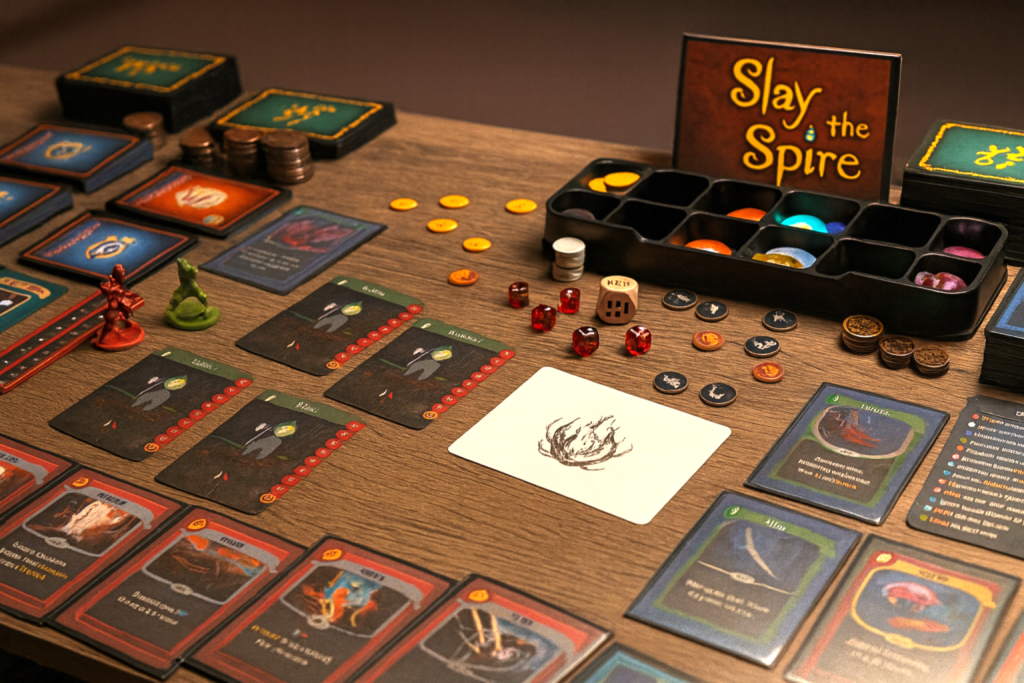
Our Game Board Setup!
A Strong Cooperative Experience
This is where the board game transcends its digital roots: it’s fully cooperative.
Playing with two people felt like embarking on a dungeon crawl as partners rather than competitors. We discussed moves, weighed risks, debated card picks, and coordinated defense and attack strategies. Many battles came down to one of us stepping in to block damage or amplify the other’s attack.
There’s a real sense of shared victory—and shared doom if things go poorly.
Some co-op games feel like solo puzzles played side-by-side. Slay the Spire does not. The synergy matters. The teamwork matters. The emotional arc of the game belongs to both players simultaneously.
Complex, But Not Overwhelming
We’ve played games far more complicated than this, and games that are much simpler. Slay the Spire lands perfectly in the middle.
There’s enough complexity to satisfy strategy lovers, but not so much that you spend the evening flipping through the rulebook. The learning curve is gentle; the depth is real. And once the mechanics click, you find yourself thinking three or four turns ahead—not because the game forces you to, but because the game invites you to.
If you like games that require planning, cooperation, and a little improvisation when the dice betray you, this one hits the sweet spot.
What We Didn’t Love
Even the best games have quirks, and Slay the Spire is no exception.
Only Four Characters
We would have loved double the character options right out of the box.
This is a game built on variety—different decks, different abilities, different synergies—and more characters would’ve increased the replay value dramatically.
To be fair, the four classes included (Ironclad, Silent, Defect, Watcher) are fun and distinct. But the board game feels like it’s begging for expansion packs. And realistically, expansions are probably coming, especially after the success of the Kickstarter.
Still, the base game feels like it could’ve shipped with at least one or two more heroes.
Physical Components Are a Mixed Bag
The board, dice, and some tokens feel visually underwhelming. The artwork itself is solid—very true to the original game—but the production design could use a touch more personality or polish.
That said, the cards are fantastic. High-quality, beautifully printed, and instantly evocative of the game’s strategic possibilities. If the rest of the components matched the cards’ quality, this section wouldn’t exist.
Should You Buy It? Absolutely.
Even with the minor criticisms, we’d recommend Slay the Spire: The Board Game without hesitation. It’s:
- Long but rewarding
- Deep but approachable
- Cooperative in all the right ways
- Strategically rich
- Packed with replay value
- And most importantly—fun the entire time
It’s not a cheap game, but it is a memorable one. If you’re looking for a game-night experience that feels like an adventure, this is worth adding to your shelf.
You can buy it here:
Whether you’re in Traverse City, Frankfort, Suttons Bay, or anywhere across Northern Michigan, this is a game that transforms a quiet evening into a cooperative quest worth sharing.