By Ray Weigel, Traverse City Web Design
I’ve been a videogame fan for a long time — publishing hundreds of reviews, essays, and articles about videogames and 3D digital culture for national media outlets. So when I sit down with a new game, especially one on iPad, I can’t help but look at it through that lens of design, simplicity, and innovation. Kingdom Two Crowns delivers all three.
At its core, the entire control scheme couldn’t be more straightforward: you ride your horse to the right, then ride your horse to the left. That’s it. But somehow, through thoughtful design, this incredibly simple mechanic becomes engaging and immersive. As you pass back and forth through your kingdom, you see your workers defending the walls, upgrading your buildings, and expanding your realm. Along the way you collect coins, make decisions, and give orders. The game makes you feel like a real king — not micromanaging every detail, but moving through the kingdom and shaping its destiny with each choice.
The visuals seal the deal. The graphics are in a retro 8-bit style, but they’re far from basic. They’re colorful, gorgeously crafted, and filled with small details that bring the world to life. The artistry shines in every tree, every torch, every reflection on the water. It’s proof that pixel art, when done with care, can be both nostalgic and beautiful.
What keeps me coming back is how Kingdom Two Crowns balances its minimalism with surprising depth. The interface is stripped down to the essentials, but that doesn’t mean the game is simple. The further you go, the more layers of strategy unfold — from how you manage resources to how you prepare for the waves of enemies that come under cover of night.
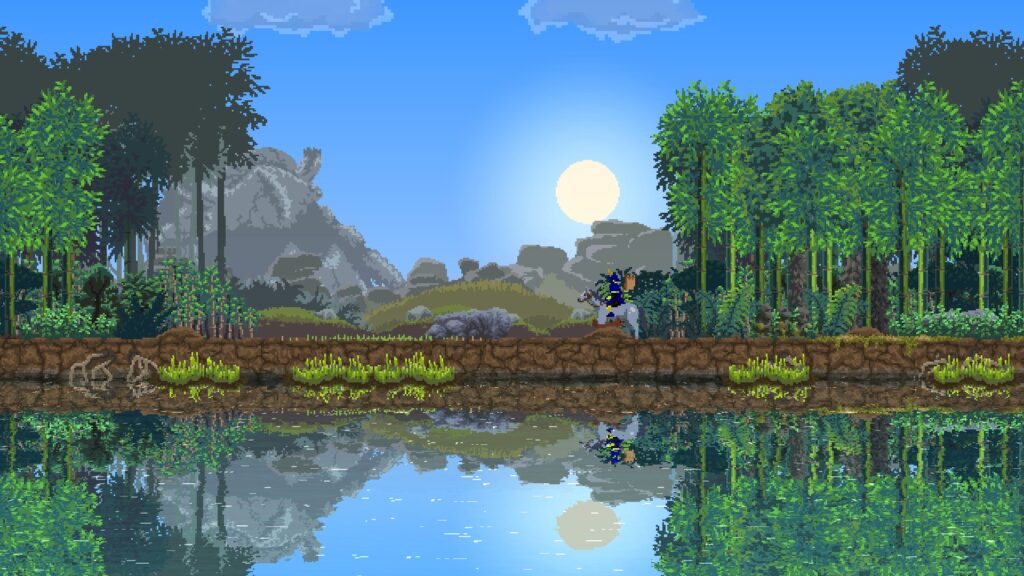
For someone like me, who spends his professional life designing websites with an eye for clean, purposeful interfaces, this game feels like a masterclass. Kingdom Two Crowns proves that sometimes all you need are the basics — if you use them brilliantly.
The genius of the design is that it trusts the player. It strips away everything unnecessary, leaving you with a single mechanic — moving left and right — and then builds an entire world of strategy and consequence around it. That kind of restraint is rare, both in game design and in digital design more broadly. It’s a reminder that clarity and elegance are often more powerful than complexity for its own sake.
When I look at Kingdom Two Crowns, I see the same design principles I try to bring into my own work: keep it simple, keep it clear, and let the experience shine. It’s a game that manages to be minimalist without ever feeling shallow, and that’s an accomplishment worth celebrating.
And maybe that’s why I enjoy it so much up here in Northern Michigan. After a long day of building websites and shaping digital kingdoms for clients, it’s strangely satisfying to saddle up a pixelated horse, ride through a retro landscape, and manage a tiny kingdom of my own. Simple, beautiful, and endlessly engaging — just the way good design should be.