Every year, Pantone drops a color into the cultural stream and waits to see how designers, brands, and critics react. For 2026, they did something quietly radical. They chose white—specifically PANTONE 11-4201 Cloud Dancer. Predictably, some people shrugged. Too subtle. Too safe. Too white.
From a web design perspective, though, this choice is anything but timid.
At Traverse City Web Design, we love Cloud Dancer precisely because it separates people who use color from people who understand it.
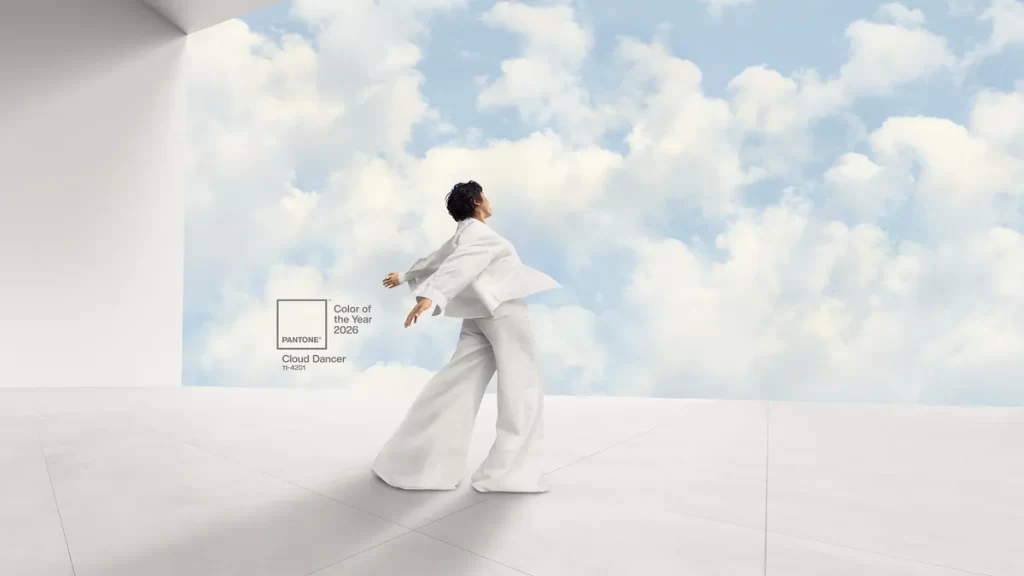
In theory, there is only one “true” white on the web: #FFFFFF. In practice, designers know that white is a spectrum. Cloud Dancer lives in that narrow, powerful band of off-whites where meaning changes with just a whisper of warmth or coolness. It’s closer to a designer’s toolkit than a paint chip—more deliberate than White Smoke, less nostalgic than Cornsilk, and far more expressive than pure digital white.
Pantone describes Cloud Dancer as a “structural color,” and that’s exactly right.
This isn’t a hue that demands attention. It creates the conditions for other hues that demand attention. It supports everything else without stealing the spotlight. Colors placed beside it appear sharper, richer, more intentional. Cloud dancer gives typography more space to breathe. It gives images more clarity, and in our eyes, makes negative space anything but negative.
Subtle differences in white matter more than most people realize – especially in web design. If you shift a background slightly warmer, it will make an image feels nostalgic. Push the white to the cooler side, and it becomes clinical. Cloud Dancer sits in a rare middle ground—bright enough to feel clean and modern, and yet soft enough to avoid sterility.
Used well, it can lift a design or quiet it, depending on what you’re asking the rest of the layout to do.
That’s why Cloud Dancer color works well in web design and across disciplines. In interiors, it creates spaces that feel open without feeling empty. In packaging and branding, it communicates confidence through restraint. In digital design—where white often becomes an afterthought—it gives structure and hierarchy without visual noise. It can be a reminder that minimalism isn’t about removing things; it’s about choosing precisely what stays.
What makes Cloud Dancer especially interesting is how it bridges time. On one hand, it aligns perfectly with modern technology—smooth interfaces, airy layouts, frictionless user experiences. On the other, it carries a strange sense of history. There’s something faintly Victorian in its refinement, like ornament stripped down to atmosphere. It feels like a future imagined in reverse: neo-retro, polished, intentional.
Think less “blank page” and more “vintage future.” The kind you’d expect in a Neal Stephenson novel. The quiet luxury of cyberpunk’s upper class. A loud voice delivered through restraint. A minimal symphony where every note matters because there are so few of them.
Cloud Dancer isn’t trying to impress anyone (but secretly it is . . .)
It rewards designers who pay attention. And in a world overloaded with color, noise, and motion, that restraint might be the boldest move Pantone could have made. We applaud them.
For us, it’s not just a color of the year. It’s a reminder that the smallest decisions—the space between elements, the shade of “almost white,” the silence between visual beats—are often where the real design lives.