Blending physical intuition with digital insight.
At Traverse City Web Design, we spend our days immersed in code, design systems, UI patterns, and the rhythms of Michigan businesses. But after hours? Some of us are out shuffling a different kind of deck!
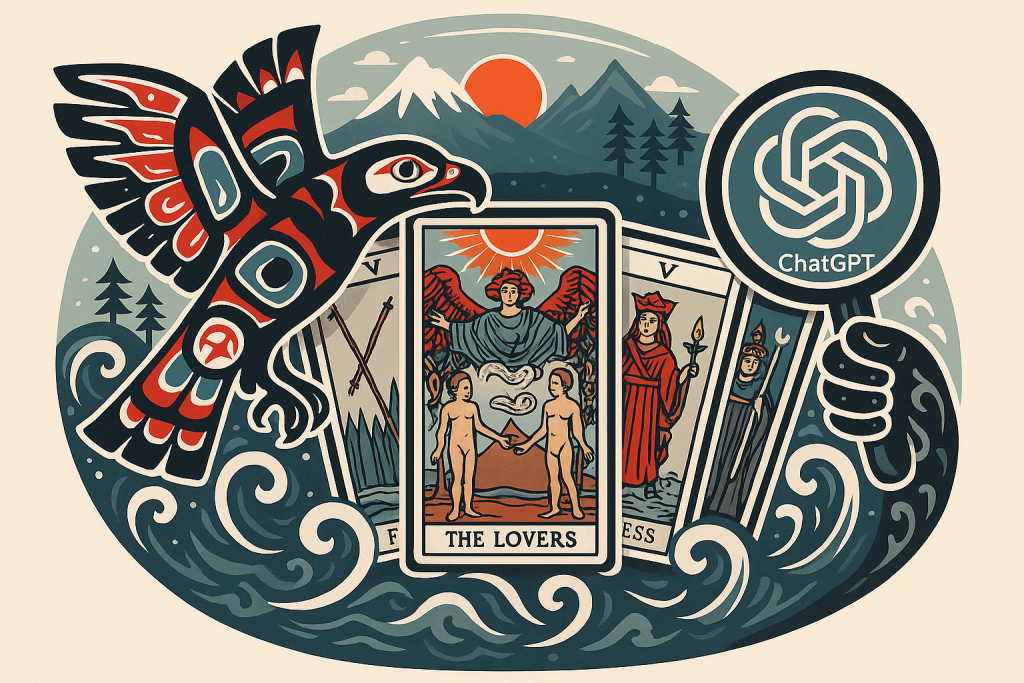
Tarot has been part of our creative ritual for years, and recently we discovered a wonderfully modern twist: using ChatGPT to help interpret readings. The idea came from a friend of ours—a woman who was using ChatGPT to read Lenormand cards for herself. It struck us immediately: what a fantastic, intuitive pairing of analog practice and digital intelligence.
Now it’s part of our own routine, especially when we want deeper layers of symbolism, correspondences, and classical interpretations without flipping through guidebooks mid-reading.
Why Use ChatGPT With Tarot?
Because the cards are still yours.
We use a standard Rider–Waite tarot deck—worn soft at the edges from years of readings. We still shuffle the deck ourselves, pull the cards ourselves, lay them out on the table ourselves. Nothing replaces that tactile, intentional connection.
ChatGPT simply becomes the reader’s companion, offering interpretations, historical context, symbolic correspondences, and clarifying insights. Think of it as having a well-read tarot scholar sitting across from you—while you remain the one doing the actual reading.
We also prefer using the conversational (voice) mode of ChatGPT. That frees our hands to stay on the cards, stay in the intuitive zone, and stay present in the moment.
Our Favorite Spreads
Like many practitioners, we mix things up depending on the question—but two spreads remain our steady companions:
-
The Three-Card Spread
Simple, clean, powerful. Perfect for daily pulls, quick relationship questions, creative direction, or work insights. -
The Celtic Cross
A classic for a reason. When we want depth, nuance, and a panoramic view of a situation, nothing beats the Celtic Cross.
Other spreads work beautifully as well—use whatever you feel drawn to. The reading is always a conversation between you, the cards, and your intuition.
How We Do It: Step-by-Step
You can follow these exact steps during your next reading:
1. Tell ChatGPT you’re doing a tarot reading.
Say: “I’m going to be doing a tarot reading using the Rider–Waite deck.”
If you use other decks, mention those too—some readers prefer Marseille, Thoth, or modern decks with unique imagery.
2. Tell it which spread you’re using.
Three-card. Celtic Cross. Horseshoe. Whatever you like.
3. Decide how you’re selecting the significator.
You can choose one intentionally (a card that represents you or your question), or simply draw it as the first card.
Tell ChatGPT which method you’re using so it understands your structure.
4. State your intention… or keep it private.
Some of us say it aloud. Some don’t. Tarot accommodates both.
5. Draw your first card.
Physically draw from your deck. As you turn it over, tell ChatGPT the card’s name, and it will begin the interpretation.
6. Continue the reading card by card.
As you lay out each position—crossing card, foundation, past, crowning, near future, hopes/fears—you simply announce the card and let ChatGPT explore its meaning.
You can ask follow-up questions, request correspondences (astrological, elemental, Kabbalistic), or ask how cards relate to one another in the spread.
7. Let the reading breathe.
ChatGPT does not replace intuition. It amplifies it—offering context, clarity, or connections you may not have considered.
Why It Works So Well
Because tarot has always lived in the middle ground between structure and intuition.
A tool like ChatGPT knows the traditional meanings, the symbolic systems behind the cards, and centuries of commentary. You know the question, the emotional landscape, and the real-life context.
Together, you get a reading that is both deep and personal.
For us, it’s become a surprisingly meaningful practice—a way to learn the cards while still honoring the ritual. And honestly? It’s just fun. We’ve had many evenings where the cards, the conversation, and the interpretations all aligned in ways that felt unexpectedly profound.
Give It a Try
If you’re already using tarot, this method blends the best of physical and digital insight. If you’re new to tarot, it’s one of the easiest ways to learn the cards while enjoying thoughtful, grounded readings.
From Northern Michigan to your table, may your spreads be clear, your cards honest, and your interpretations bright.