Search engine optimization used to be a little easier to define. At its core, the work was about creating useful content, organizing it clearly, and helping Google understand what your business does, where you are located, and why your website should appear when someone searches for your services.
That foundation still matters.
What has changed is the search landscape around it. People are no longer only scanning traditional search results. They are also getting answers from featured snippets, voice assistants, AI Overviews, ChatGPT, Perplexity, Gemini, Copilot, and other systems that summarize information instead of simply listing links.
That shift has introduced two newer terms: AEO and GEO.
AEO means Answer Engine Optimization.
GEO means Generative Engine Optimization.
They are not exactly the same thing, but they are closely related. Both are concerned with how clearly your website communicates its meaning to search engines, AI tools, and answer-based systems. Both depend on strong content, clean structure, useful explanations, and a website that gives machines enough context to understand the business behind the page.
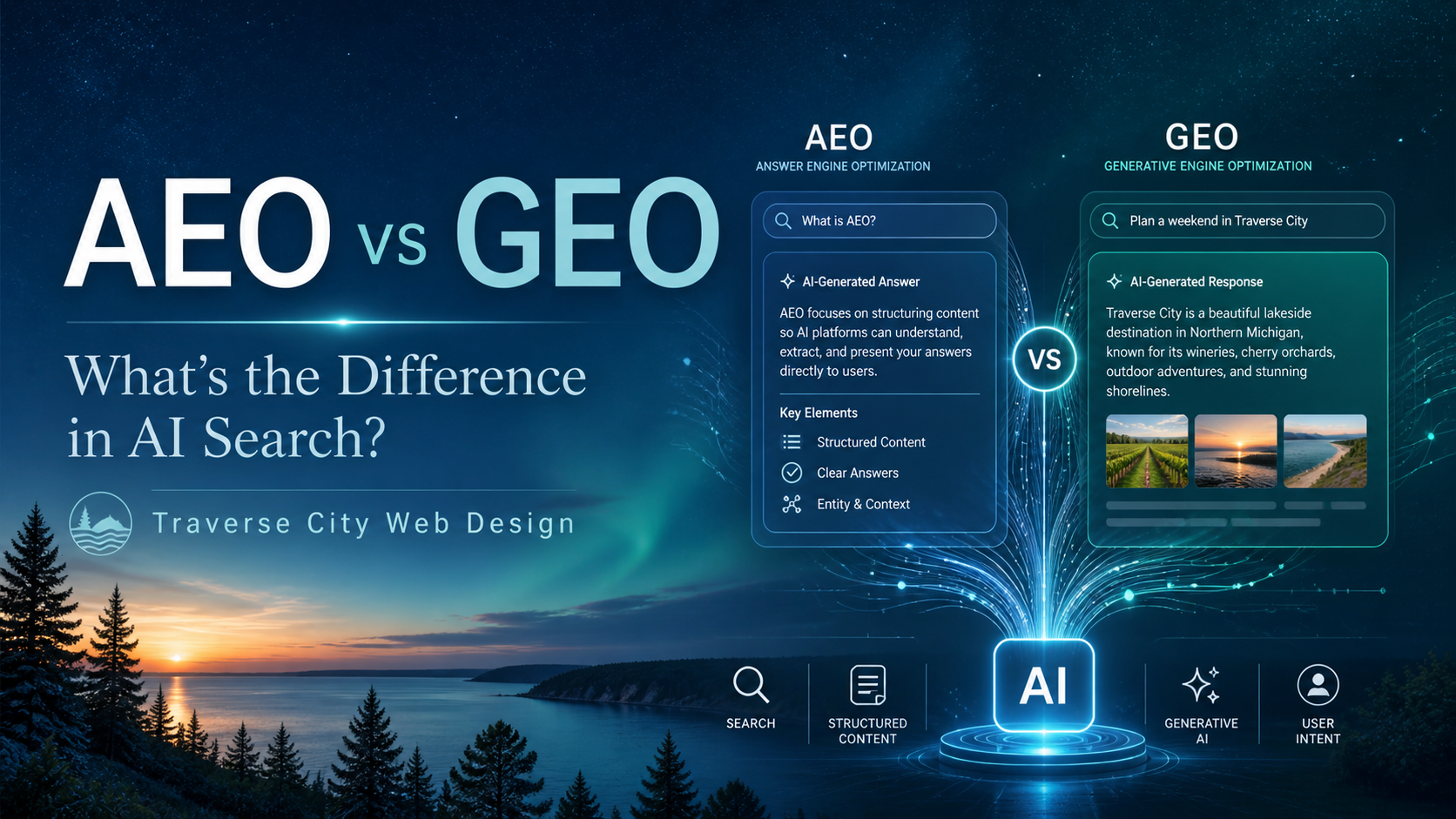
The main difference is where your content appears and how it is used. AEO is focused on helping your content become a clear answer. GEO is focused on helping your content become part of an AI-generated response.
What Is AEO?
AEO stands for Answer Engine Optimization.
AEO is about shaping website content so it can respond to specific questions with clarity, authority, and context. It is not simply about adding an FAQ section or stuffing a page with question-based headings. It is about understanding how people search, how they phrase their questions, and how answer-based systems evaluate whether a page contains information worth extracting.
The concept itself is not new. Long before ChatGPT, Google AI Overviews, and other generative search tools entered the conversation, search engines were already moving beyond the old blue-link model. Featured snippets, FAQ results, knowledge panels, voice search, and “People Also Ask” sections all pointed toward the same larger shift: search engines were no longer just helping people find pages. They were trying to answer questions directly.
For example, someone might search:
“What does a web design company do?”
A traditional SEO approach might try to rank a service page for that phrase. A stronger AEO approach asks a slightly deeper question: does the page actually answer it well?
That answer should not be buried halfway down the page, hidden inside vague marketing language, or scattered across disconnected sections. It should be clear, useful, and positioned in a way that both visitors and search systems can understand. A good answer explains the subject directly, then gives enough supporting context to make the answer meaningful.
For a web design company, that might mean explaining that a web designer helps plan, design, build, structure, and maintain a website — but it should also go further. It can explain how design affects user experience, how content structure supports search visibility, how mobile performance matters, and how the website fits into the broader goals of the business.
That is where AEO becomes more than a formatting technique. It becomes a content strategy.
AEO asks your website to be more precise. It pushes every page to clarify what it knows, who it serves, what questions it answers, and why its information can be trusted. When done well, it creates content that is useful for visitors first, while also giving search engines and answer systems the structure they need to recognize, interpret, and potentially surface that information.
That usually means using:
- Clear headings
- FAQ sections
- Direct question-and-answer formatting
- Short, useful definitions
- Schema markup where appropriate
- Well-structured HTML
- Relevant internal links
- Specific, helpful page content
What Is GEO?
GEO stands for Generative Engine Optimization.
This is a newer term. It refers to optimizing your website so it can be found, understood, cited, or summarized by generative AI systems like ChatGPT, Perplexity, Google Gemini, Claude, Bing Copilot, and Google’s AI search features.
A research paper on GEO described it as a framework for helping content creators improve visibility in responses generated by AI-powered search systems. In other words, GEO is about making your content useful and understandable to systems that generate answers rather than simply listing search results.
Traditional search engines usually show a list of links.
Generative engines often synthesize an answer from multiple sources.
That changes the game.
Instead of asking, “How do we rank number one on Google?” businesses also have to ask:
- Will AI understand what we do?
- Will it trust our site as a source?
- Will it include our business in a summarized answer?
- Will it connect our services to the right location, industry, and topic?
- Will it accurately describe our company?
That is the heart of GEO.
So, Are AEO and GEO the Same Thing?
Not exactly — but they are closely connected.
The simplest way to separate them is this:
- AEO helps your content become the answer.
- GEO helps your content become part of an AI-generated response.
AEO is usually focused on direct answers: definitions, FAQs, featured snippets, voice search, and question-based search results. It is about making sure your content can answer a specific question clearly and efficiently.
GEO is broader. It is concerned with how generative AI systems interpret your website, understand your expertise, summarize your content, and potentially cite or reference your business in a larger AI-generated answer.
So while the terms are different, the practical work behind them is very similar. Both depend on clear writing, strong page structure, useful explanations, trustworthy information, and a website that gives search engines and AI systems enough context to understand what your business actually does.
Both depend on:
- Clear content
- Strong page structure
- Accurate information
- Helpful explanations
- Good headings
- Specific service pages
- Local relevance
- Trust signals
- Readable HTML
- Consistent business information
So no, AEO and GEO are not exactly the same thing.
But for most small businesses, the strategy is nearly identical.
Why This Matters for Small Businesses
For local businesses, this matters a great deal.
When someone searches for something like:
“Who builds WordPress websites in Traverse City?”
Or asks an AI tool:
“Find me a Michigan web design company that works with small businesses and WordPress.”
Your website needs to make the answer unmistakably clear.
It should not require the visitor, the search engine, or the AI system to infer what your company does from a handful of attractive images and a vague tagline. Your website should state, with confidence and consistency, who you are, what services you provide, where you are located, what areas you serve, who your ideal clients are, and why your company is a strong fit for that specific need.
This is where strong website structure becomes essential.
A website cannot rely on visual design alone. The design may create trust, mood, polish, and a sense of professionalism, but the underlying content and HTML structure create meaning. Search engines and AI systems depend on that structure to understand the story of your business.
They are not looking at your website the way a human visitor does. They are reading signals. They examine page titles, headings, body content, internal links, image descriptions, schema markup, service pages, location references, testimonials, case studies, and the recurring patterns of language that appear throughout your site.
If those signals are clear, consistent, and specific, your website becomes easier to interpret. It tells search engines and AI tools:
This company builds WordPress websites.
This company serves Traverse City and Northern Michigan.
This company works with small businesses.
This company has experience with web design, SEO, hosting, and ongoing website support.
A beautiful website with vague content may still impress a human visitor for a moment, but it may fail to communicate enough meaningful information to search engines, Google AI Overviews, ChatGPT, Perplexity, Gemini, or other answer-based systems. If your site does not clearly explain what your business does, where it does it, and why it matters, those systems may pass over you in favor of competitors whose websites are more direct, better organized, and easier to understand.
In other words, your website needs to be more than attractive. It needs to be legible. It needs to be structured. It needs to give search engines and AI systems a clear, repeated, well-supported understanding of your business. For local companies, that clarity can make the difference between being visible when people are actively searching for your services and being buried beneath businesses that have made their meaning easier to find.
Google’s AI Search Makes This Even More Important
Google now includes AI-powered search features such as AI Overviews and AI Mode. These features are designed to provide summarized answers while still connecting users to deeper information on the web.
Google’s own guidance continues to emphasize helpful, people-first content and making sure pages can be accessed, crawled, and understood.
That is an important point. AI search does not mean the basics are dead. It means the basics matter even more.
Your website still needs:
- Strong titles
- Clear headings
- Useful content
- Fast-loading pages
- Mobile-friendly design
- Technical accessibility
- Clean internal linking
- Original service descriptions
- Specific local information
- Trustworthy business details
AEO and GEO are not magic tricks. They are extensions of good website strategy.
The Real Difference Between SEO, AEO, and GEO
Here is the simple version.
- SEO helps your website appear in traditional search results.
- AEO helps your website answer specific questions clearly.
- GEO helps your website be understood and potentially included in AI-generated answers.
They are not separate kingdoms. They are layers of the same digital foundation. A strong SEO strategy supports AEO. A strong AEO strategy supports GEO. And all of them depend on a website that is well written, well structured, technically sound, and genuinely useful.
What This Means for Website Content
This is why content structure matters so much.
A service page should not simply say:
“We offer great web design services.”
It should explain:
- What kind of websites you build
- Who you build them for
- What platform you use
- What problems you solve
- What towns or regions you serve
- What makes your process different
- What clients should expect
- What questions people commonly ask
That kind of content gives humans useful information. It also gives search engines and AI tools the context they need.
The same HTML tools that help traditional SEO also help AEO and GEO:
- H1 headings tell the page’s main topic.
- H2 and H3 headings organize supporting ideas.
- Paragraphs explain meaning.
- Lists make information easier to scan.
- Image alt text gives images context.
- Internal links show relationships between pages.
- Schema markup can clarify business details, FAQs, services, and locations.
This structure helps create the meaning of your website.
And in the age of AI search, meaning matters.
The Bottom Line
AEO and GEO are different terms, but they are not entirely separate strategies.
They belong to the same larger shift in how people find information online.
AEO, or Answer Engine Optimization, is focused on helping search engines and answer-based systems extract clear, direct, reliable answers from your content. It is concerned with questions, definitions, summaries, FAQs, featured snippets, voice search, and other places where a search tool tries to provide an immediate answer instead of simply listing websites.
GEO, or Generative Engine Optimization, is focused on how generative AI systems interpret, summarize, compare, and potentially cite your website within AI-generated responses. Instead of only trying to rank as a blue link on a search results page, GEO is concerned with whether your business becomes part of the answer itself.
The distinction matters, but it should not become a distraction.
For most businesses, the practical work behind AEO and GEO is deeply connected. Both depend on clarity. Both depend on well-structured content. Both depend on specific language, useful explanations, strong page organization, credible signals, and enough context for search engines and AI systems to understand what your business actually does.
AEO asks:
Can this page answer a specific question clearly?
GEO asks:
Can this website be understood, summarized, trusted, and referenced by an AI system?
Those are different questions, but they point toward the same discipline: building a website that communicates meaning with precision.
That means your website should not be built around vague marketing language, thin service pages, or generic claims that could apply to any company in any city. It should explain who you are, what you do, where you work, who you serve, what problems you solve, and why your experience matters.
For most businesses, the best strategy is not to chase every new acronym as if it were a separate marketing universe. The better strategy is to build a strong, clear, useful website from the ground up.
A website with thoughtful structure, well-written content, properly organized headings, service-specific pages, location signals, internal links, schema, FAQs, and helpful explanations is better positioned for traditional search, answer engines, and generative AI systems alike.
In other words, AEO and GEO may describe different parts of the modern search landscape, but they both reward the same underlying work: clarity, usefulness, authority, and structure.
That means:
- Good design
- Good writing
- Good structure
- Good technical performance
- Good local signals
- Good answers
At Traverse City Web Design, this is how we think about modern websites. A website should not only look polished on the surface. It should be built with meaning underneath — structured clearly for visitors, search engines, and the new generation of AI-powered search tools.
The names may keep changing.
SEO. AEO. GEO.
But the foundation remains the same: build a website that clearly explains who you are, what you do, where you do it, and why people should trust you.