Understanding ADA Website Accessibility
Accessibility has become one of the most important — and often misunderstood — parts of modern web design. For businesses, municipalities, and organizations across Michigan, an accessible website is no longer optional or something to consider “later.” It is a core part of how a website functions, how it serves the public, and how it represents your organization online.
Today, a website is often the first place people interact with your business or organization. If that experience is difficult to navigate, hard to read, or unusable for someone relying on assistive technology, that visitor is effectively excluded. Accessibility addresses this directly by ensuring that websites can be used by as many people as possible, regardless of ability or circumstance.
For many organizations, accessibility also carries legal weight. Requirements tied to public access, federal guidelines, and civil rights protections have made accessibility a growing area of focus — especially for municipalities, libraries, schools, healthcare providers, and service-based businesses. Beyond compliance, it has also become an expectation. Users increasingly assume that websites will be easy to navigate, readable, and functional across a wide range of devices and needs.
At Traverse City Web Design, accessibility is a regular part of client conversations. Business owners and organizations often ask what ADA compliance actually means, whether certifications matter, and how accessibility applies to their specific website. These are practical questions, and the answers are not always straightforward.
This guide is designed to clarify those questions. It explains what ADA website accessibility is, outlines the standards that define it, and provides context around certifications and real-world implementation. The goal is not just to define accessibility, but to show how it applies to the websites Michigan organizations rely on every day.
What ADA Website Accessibility Means
When people refer to “ADA compliance” for websites, they are typically talking about designing and developing a site so that it can be used by individuals with disabilities. This includes people who rely on screen readers, keyboard-only navigation, voice input systems, or other assistive technologies to browse the web.
Accessibility covers a wide range of considerations. It includes how content is structured, how navigation works, how text is presented, and how interactive elements like forms and menus behave. A website that is visually appealing but difficult to navigate with a keyboard or unreadable by a screen reader is not truly accessible.
The most widely accepted technical standard for accessibility is the Web Content Accessibility Guidelines, commonly known as WCAG. These guidelines were developed by the World Wide Web Consortium and provide a detailed framework for making websites more accessible. WCAG is organized around principles such as making content perceivable, operable, understandable, and robust across different technologies.
In the United States, accessibility is connected to laws such as the Americans with Disabilities Act (ADA) and Section 508. While the ADA itself does not include a specific technical checklist for websites, courts and regulatory bodies consistently look to WCAG as the benchmark for determining whether a website is accessible.
As a result, ADA compliance in practice usually means aligning a website with WCAG standards, most commonly at the WCAG 2.1 Level AA threshold. This has become the de facto standard for organizations that want to ensure their websites meet both usability expectations and legal considerations.
Why Accessibility Matters for Your Website
Accessibility is not just about compliance — it directly shapes how people experience your website from the moment they arrive. A website is often the first point of contact between your organization and the public, and that interaction needs to be clear, usable, and welcoming to everyone. If a visitor cannot navigate your site, read your content, or complete a basic action like filling out a form, the opportunity is lost before it even begins.
In many cases, accessibility improvements overlap with good design. Clean structure, readable typography, intuitive navigation, and thoughtful content organization all contribute to a better experience for every user. What begins as an effort to support accessibility often results in a stronger, more effective website overall — one that communicates clearly and performs consistently across devices and use cases.
Accessibility also plays a growing role in how websites are evaluated by search engines and users alike. A site that is easy to navigate, properly structured, and clearly labeled is easier for search engines to understand and index. At the same time, users are more likely to trust and engage with a site that feels polished, functional, and easy to use.
- Allows more people to use your website, regardless of ability
- Improves overall usability for all visitors
- Strengthens search engine visibility
- Reduces legal risk
- Builds trust with your audience
In Northern Michigan and across the state, this is especially important for organizations that serve the public. Municipalities, libraries, healthcare providers, and service-based businesses often rely on their websites to share essential information and connect with their communities. When those websites are accessible, they function as reliable tools that people can depend on. When they are not, they create barriers that can limit access to important services and information.
Ultimately, accessibility is about more than checking a box. It is about building a website that works — consistently, clearly, and for as many people as possible. When accessibility is treated as a core part of the design process, the result is a website that is stronger, more resilient, and better aligned with the needs of the people it serves.
Do Web Designers Need Accessibility Certifications?
Accessibility certifications are not legally required to build a compliant website. A website can meet accessibility standards without any formal credential behind it. However, certifications provide structured knowledge and a recognized framework for understanding how accessibility works in practice. They signal that a designer or developer has taken the time to study accessibility in a formal way, rather than approaching it casually or reactively.
For agencies and professionals, certifications can serve several important roles. They demonstrate a working familiarity with established standards, help create a shared vocabulary when communicating with clients, and provide a consistent reference point when making design and development decisions. This can be especially valuable when working with municipalities, educational institutions, or organizations that have specific compliance expectations.
Certifications also help bring clarity to a complex topic. Accessibility involves a wide range of considerations, from visual design and content structure to technical implementation and user interaction. A formal certification process organizes these ideas into a cohesive system, making it easier to understand how different elements of a website contribute to overall accessibility.
At the same time, it is important to recognize the limits of certification. Holding a credential does not automatically result in an accessible website, just as the absence of one does not mean a site cannot meet accessibility standards. Accessibility is not something that can be applied once and considered complete. It is an ongoing process that continues throughout the life of a website.
Real accessibility comes from how a website is designed, built, tested, and maintained over time. It involves making thoughtful decisions about structure, navigation, color contrast, and content. It requires testing with real tools and, ideally, real users. It also depends on how content is updated and managed after launch, since even small changes can introduce new barriers if accessibility is not considered.
In practice, the most effective approach combines knowledge with execution. Certifications can provide a strong foundation and help guide best practices, but the true measure of accessibility is how well a website functions for the people using it. A well-built accessible site reflects not just an understanding of standards, but a commitment to applying them consistently and thoughtfully in real-world situations.
The Two Most Recognized Accessibility Certifications
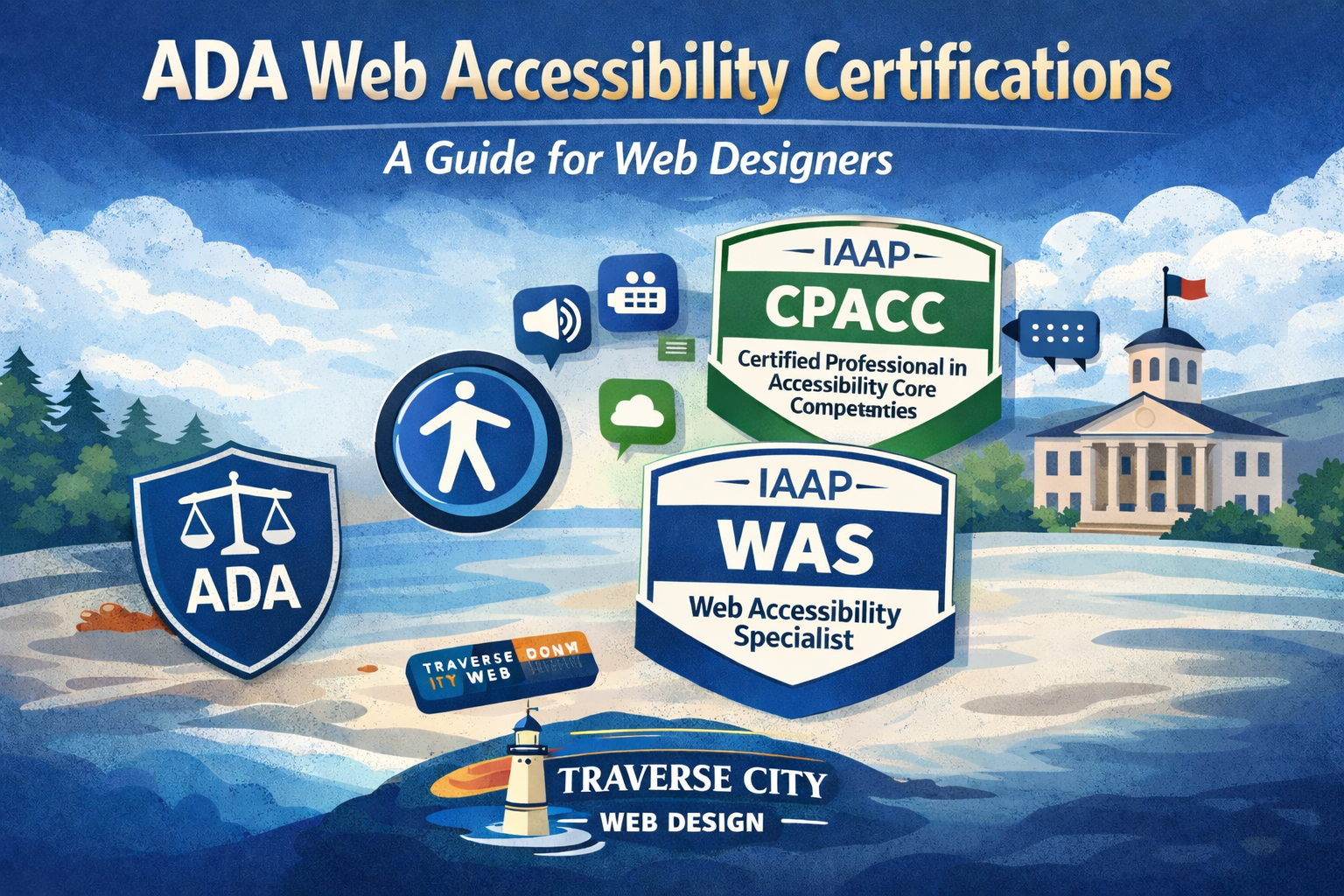
The most widely respected certifications in the web accessibility field come from the International Association of Accessibility Professionals, usually referred to as IAAP. These credentials are recognized across industries, including government, education, and enterprise organizations.
CPACC — Certified Professional in Accessibility Core Competencies
The CPACC certification focuses on foundational knowledge. It is designed for professionals who want to understand accessibility at a conceptual and strategic level. This includes the principles of accessible design, different types of disabilities and how they affect web use, assistive technologies such as screen readers, and legal frameworks like the ADA and Section 508.
CPACC is often the starting point for designers, content creators, and project managers. It provides the broader understanding behind accessibility and helps professionals grasp why accessible digital experiences matter.
WAS — Web Accessibility Specialist
The WAS certification is more technical and directly related to web design and development. It focuses on applying WCAG guidelines in real-world websites, writing accessible HTML, using ARIA attributes appropriately, testing websites for accessibility issues, and fixing common accessibility barriers.
For web designers and developers, this is the certification that connects most directly to the actual work of building accessible websites.
The Combined Credential: CPWA
When both certifications are earned together, they form the CPWA, or Certified Professional in Web Accessibility. This combined credential represents both a strong conceptual understanding of accessibility and the technical ability to apply that knowledge in practice.
How These Certifications Apply to Real Websites
Certifications are valuable, but accessibility ultimately comes down to execution. A truly accessible website is built with a clear structure, readable content, and user-friendly functionality that supports a wide range of needs and technologies.
- Proper heading structure using a clear H1, H2, and H3 hierarchy
- Alt text for images
- Keyboard navigation support
- Strong contrast between text and background
- Accessible forms and labels
- Logical page structure and readable content
In platforms like WordPress and Elementor, tools such as accessibility plugins can assist with parts of this work, but they do not replace proper design and development practices.
Accessibility for Michigan Organizations
In Michigan, accessibility requirements are especially important for public-facing entities. Many municipalities and organizations align with WCAG 2.1 Level AA standards. This often includes government websites, public libraries, schools, educational institutions, and healthcare providers.
For these organizations, accessibility is not simply a best practice. It is often tied to compliance expectations, public service responsibilities, and broader efforts to make information available to everyone.
Common Misconceptions About ADA Compliance
There are several misunderstandings that often come up around accessibility. One of the most common is the idea that installing a plugin automatically makes a website compliant. While tools can help identify issues or improve certain user experiences, they do not guarantee compliance.
Another misconception is that accessibility is a one-time project. In reality, it is an ongoing process that continues as content is added, updated, and revised. It is also important to understand that accessibility is not just about passing automated scans. Many issues require human review and thoughtful decision-making.
How Traverse City Web Design Approaches Accessibility
At Traverse City Web Design, accessibility is integrated into the design and development process rather than treated as an afterthought. We believe accessibility should be part of the structure of a website from the beginning, not layered on at the end.
- Structuring websites with clean, semantic HTML
- Building layouts that support screen readers and keyboard navigation
- Ensuring strong color contrast and readability
- Using Elementor accessibility enhancements where appropriate
- Testing and reviewing sites for usability across devices and assistive technologies
For municipal and public-sector clients, we align with WCAG guidelines and incorporate accessibility considerations from the ground up.
Should Your Business Pursue Certification?
For most business owners, certification is not necessary. What matters is working with a team that understands accessibility and can implement it effectively. For web designers and agencies, however, certifications can be a worthwhile investment, especially when working with government, institutional, or public-sector clients.
Building a More Accessible Web
Accessibility is ultimately about creating websites that work for everyone. It improves usability, strengthens your brand, and helps ensure your website can serve the widest possible audience. Certifications like CPACC and WAS provide a strong framework, but the real value comes from applying those principles in thoughtful, practical ways.
For Michigan businesses and organizations, an accessible website is not just a technical upgrade — it is a commitment to clarity, inclusivity, and long-term reliability.
If you are planning a new website or want to improve the accessibility of your existing one, Traverse City Web Design can help guide the process and ensure your site is built with accessibility in mind from the start.